How to Copyright AI Music Properly: What Creators Need to Know
Artificial Intelligence has changed the way music is created. Today, anyone can type a prompt and receive a full instrumental track in seconds. That can feel exciting, empowering, and even magical. But there’s an important truth many creators don’t realize until it’s too late: AI generated music is not legally yours in the same way human-created music is. So, How to Copyright AI Music?
This article explains, in simple terms, what AI music can and cannot do for you — and how to turn an AI idea into something you can truly protect, own, and monetize.
Why AI Generated Music Can’t Be Copyrighted
Copyright law in most countries is very clear on one fundamental principle: only human creation can be copyrighted.
When music is generated entirely by an artificial system, even if you wrote the prompt, the resulting composition is not considered a human work. The AI did the creative act, not you. Because of that, there is no legal author in the traditional sense.
This means:
You cannot register AI-generated music as your copyright
You cannot stop others from using the same or very similar track
You cannot sue someone for reusing or selling an identical AI-generated song
In fact, two people using similar prompts could legally generate extremely similar music, and neither would have exclusive rights.
Can You Use and Sell AI Music?
Yes, but with limits.
You can:
Use AI music in videos, content, demos, or background music
Sell AI-generated tracks depending on the platform’s license
But you must understand the risk: there is no legal protection. If someone else uses the same music, or something almost identical, you have no ownership claim.
This is why AI music works well for inspiration, sketches, mockups, or references, but not for creators who need legal certainty.
Inspiration vs. Ownership
AI is a fantastic creative assistant. It can help spark ideas, suggest harmonic directions, or inspire arrangements. Used this way, it’s powerful and perfectly valid.
The problem starts when creators believe AI output equals authorship.
If you are building a brand, releasing music commercially, or licensing tracks for theater, film, churches, or professional productions, ownership matters. And ownership requires human creation.
The Missing Step: Human Re-Creation
This is where professional production comes in.
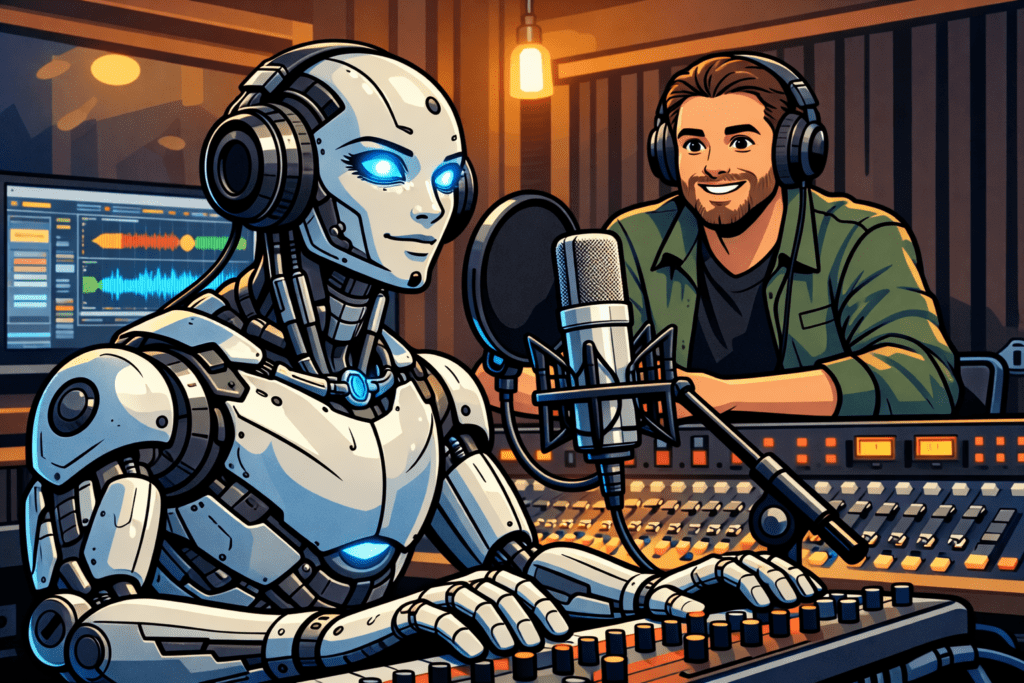
If you take an AI-generated track and hand it to a human recording engineer, arranger, and musician, something important changes: the music becomes human-authored.
When the song is:
Re-recorded with real instruments
Re-arranged with artistic decisions
Interpreted by a human ear and experience
…it is no longer an artificial output. It becomes a new, human-touched musical work, eligible for copyright protection.
How to Copyright AI Music
I’ve spent almost 30 years as a recording engineer and arranger, creating custom backing tracks for professional singers, theater productions, and musical companies around the world.
If you bring me an AI-generated song:
I will re-record the entire track from scratch
Arrange it musically with human decisions you’ll take
Improve the sound, dynamics, and realism
Deliver a copyrightable, human-created backing track
By adding the human touch, this recording change will allows you to legally protect your music and confidently use it for commercial projects.
If you’re searching for How to copyright AI music properly, this is the safest and most professional path available today.
If you want to transform an artificial idea into a legally protected, professional-grade backing track, and do it for a very reasonable price, I’d be happy to help.
Reach out, and let’s turn your idea into real music you truly own
Visit my recent projects page, or my news section to take a listen to what I do. Or if you prefer you can download more than 20.000 backing tracks I’ve created among the years.